Viewing the foreground, the background, and that mid-ground, so elusive and yet rewarding

Churchmen
Deeply rooted, stolid sentinels against encroaching growth. Seemingly impervious to the opportunistic creeping scrub, yet aware of the long-term outcome. They are scabbed, scarred – relics of another era awaiting … what? Waiting to become duff. The shallow rooted deciduous upstarts are loath to wait for the old giants to topple. Then the forest will change. For the better? (October 2, 2020)
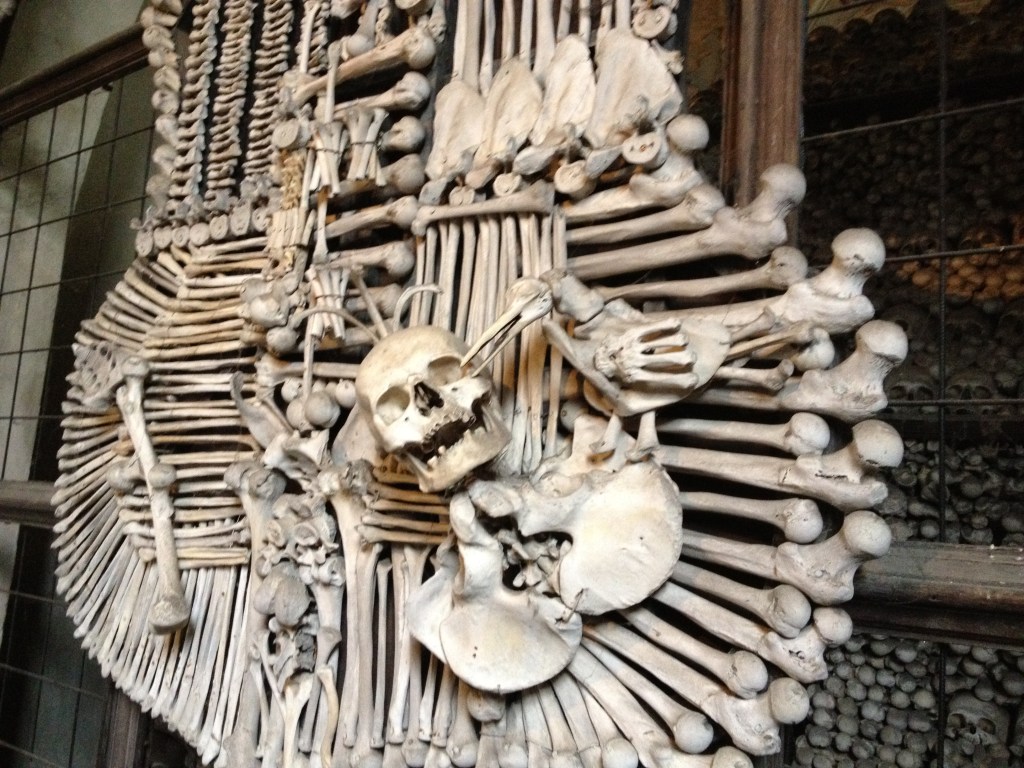
Insatiable?
Birds of prey are carrion birds. Eagles gorging on salmon carcasses. Buzzards convened around a corpse on the road. Crows picking at flattened trash, dodging vehicular traffic, persistent. Pecking, picking – ravens drawn to a gibbet – morose, grotesque, sardonically thorough. They depart only when driven or satiated.
Death is insatiable. It is the last and final enemy of man, coldly efficient. It picks and pecks even when no meat is left on the bone, no morsels left to pluck, no residual red to scrape. Thus it is in this life: we live, we die, we are forgotten.
But lo, there breaks a yet more glorious day; The saints triumphant rise in bright array; The King of Glory passes on His way. Alleluia! Alleluia!


Leisurely Reflection
Solitude and the proper perspective often seem necessary for satisfying reflection. Alas, these are elusive commodities in our oft-frantic lives. Only rarely does the way forward seem quite so straight. Perhaps if it appears so in my thoughts, even the serpentine path can become a series of more manageable segments. A moment more to pause, to think, to breathe, and then onward to the journey. – April, 2014

Autonomy
Words are wonderful, for words have meaning. Some years ago my wife bought me a little pocket dictionary from 1921 to carry around with me because I love words. I would just take it out and look up random words. I love to discover the meaning of words, to learn their history, to grasp the nuances they can express, and to enlarge my vocabulary. I have even been accused of ‘making up words’ at times (although I prefer the term ‘coining’ new words).
This week I have been thinking a lot about words, especially the auto-_______ words. Words like: automobile – a car that powers itself; autofocus– a camera feature in which the lens is self-focusing; autoimmune – the ability of the body to protect itself from cellular injury; automatic – to be self acting; and autopilot –that feature that allows a vehicle to navigate itself. The prefix auto in these words comes from the Greek pronoun autos which means “self”.
This leads me to a troubling word. Autonomy. This comes from autos (self) + nomos (law) and can mean “self-governing”. We are familiar with autonomy because it can speak about the kind of self-reliance that Americans prize. Parents want their children to learn to think for themselves and to make their own decisions. Employers might prize an employee who is self-motivated. Such an employee might even be given some autonomy in the workplace to set their own schedule or identify their own tasks. Autonomy can be a good concept in the right context.
Autonomy can be a troubling word however, especially when it comes to the life of faith. Autonomy can refer to the insistence upon self-determination, or being a ‘law unto myself’ (literally). Such insistence upon self governance is not the will of God, who calls us to ‘love your neighbor as yourself’. An insistence upon autonomy can go beyond self-before-others and become a resistance to God Himself and His will for our lives. It can be self-before-God. It can declare “nobody is the boss of me, not even God!” It can be the desire to ‘cut the strings of control’ which God has over us as our Lord. It can risk terminating that relationship. Indeed, it has been said that in the life of faith, that autonomy is rebellion against God and the assertion that “I will be my own god!” You will remember that when King Saul put self- considerations before those of God in 1 Samuel 15, God’s caution was that “to obey is better than sacrifice … for rebellion is as the sin of divination”.
Christians are called not to autonomy, but to service. Rather than putting self first, we are called to put others first. Indeed we are called to put GOD first – as we have learned from Luther to understand the 1st Commandment: you shall no other gods. We should fear, love, and trust in God above all things. Certainly this is a trouble for us, for we are all sinful, and the 1st Commandment lies at the heart of all the other Commandments. We are stuck, indicted by God’s command, shown for what we are: people who want to be autonomous. How can we find hope from our desire for autonomy?
The Parable of the Good Samaritan (Luke 10.30) highlights a great example of selfless love of God and neighbor. You remember the parable – a man was robbed and beaten and left for dead. He was ignored in his dire need by good, religious people who were more concerned with themselves than with others. It was finally an outcast, a Samaritan who stopped and put the injured man’s need before his own. It is a great story, but not much comfort to me, because I am rarely that Good Samaritan. Am I ever that Good Samaritan? But is the story really about me?
Who is the Good Samaritan? Who is the One who puts the needs of others before Himself? Who is the One for whom obedience to God was essential, and yet was willing to stoop to be with the disobedient, the self-absorbed, the rebellious, the ones who insist upon autonomy? Who is the One willing to die that I might live? Who is the One willing to take my place on the cross under the wrath of God that I might enjoy God’s favor? Who is THAT ONE?
That One is Jesus. That One is the Lamb of God who takes away the sin of the world. That One is the One who has redeemed me a lost and condemned person, purchased and won me … so that I might live under Him in His Kingdom and serve Him. Jesus is that One!
from January 27, 2017

Relative Value
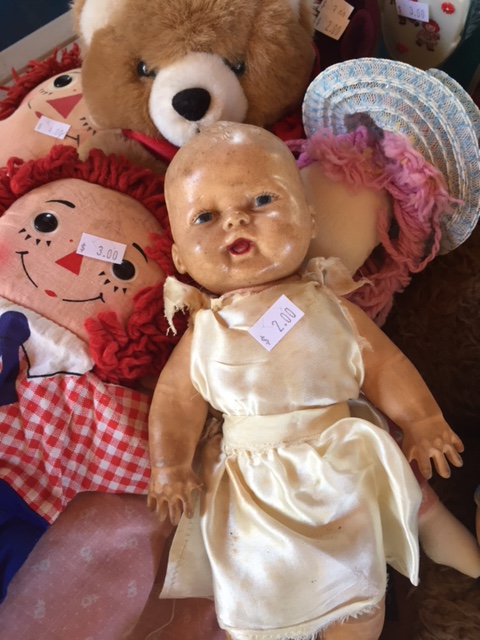
The story is an old one. A mother lovingly cradles her infant daughter, coos to her, and strokes her face. As her daughter becomes a toddler, and then a preschooler, toys are purchased and then outgrown. The 5 year old enters primary school and learns new friends and acquires new interests. The 3rd grader wants a dolly to love and pack about, “just like Mommy”. Along comes Raggedy, Baby Lucy, and Teddy. The 8th grader wants electronic distractions, not ‘those old things’. The dolls are boxed up and set aside. Not exactly forgotten, but the memory of them fades.
After enough time, Mommy becomes Gramma, and ‘those old things’, long since packed away are rediscovered and reclaimed. A new generation of little girls learns to love and care for these dolls. Inevitably however, they are again set by the wayside; boxed up, set aside once more. Again they fade from ready thought.
Gramma gets older, infirm; Grampa dies. Gramma loses her independence. Finally she is gone too – boxed up and set aside. Remembered, but increasingly less so. The children and grandchildren are given the task of going through the boxes, scheduling an estate sale, and disposing of ‘those old things’. Old acquaintances (surely no longer old friends), rediscovered yet again though unappreciated for what they were, and labelled for quick disposal. Their value determined and marked with tags, considerably beneath the value they once had. Value is relative, we opine.
At a recent meeting for church leaders, the health of the institution was discussed. Growth charts, statistical trends and cultural dynamics were instructive. New observations and theories about change-management were highlighted and promoted as templates for congregational life and health. Familiar graphs of growth / plateau / decline / demise were projected to raise awareness and vision. “Grow or die – it’s your choice”. “Are you willing to do what it takes to survive?” Value becomes relative.
To best sure, institutional stability is essential. Financial health is a necessary part of congregational life. Correction of faulty processes and the restructuring required for engaging a new culture, a new generation, a new reality is apropos. In the process however, what gets boxed up and set aside?
A congregation is a collection of congregants. The corporate whole is the organic society of individuals. What about the individuals? Are dear, old friends to be boxed up and set aside? What about Raggedy Ann and Andy, soiled and marked? What of Baby Lucy with her squishy torso and stiff arms? What about Teddy with his matted fur? Are they to be boxed up and set aside? What of their value?
A dear friend has often reminded us that “in the church we are in the people business”. Indeed we are. We care for the people in the congregation. We prize the individuals who sit in our pews. We honor the ones marked with the cross at the font, the ones belonging to Christ. They may have been marked many years ago, the memory of the action lost to all who now survive. The marking may have been last week, eager parents standing at the font with this newly minted, cooing infant.
When someone gets older, worn, soiled and ratty they still have value. Perhaps they become more valuable, in a certain economy. We give them extra care, show more patience with their ragged memories and repetitious tales. Eventually we again cradle them, cooing and stroking their translucent skin, made delicate by many years of love and affection. They are valued.
This is what it is to be a pastor, to be a friend, to be a family. This is what it is to be church, a congregation, a society of those who love and care, and who are in turn loved and cared for. Charts and strategies have no place here, at least no proper place. Here there are people, valuable people. Here there is value that goes beyond circumstances and performance. Here “relative” is not with respect to age or shabbiness, but with respect to the value that God set upon the baptized. Here value is not relative, changing with circumstances and condition. Here value is set by God.
… Knowing that you were ransomed from the futile ways inherited from your forefathers, not with perishable things such as silver or gold, but with the precious blood of Christ, like that of a lamb without blemish or spot. 1 Peter 1.18-19
from September 17, 2016

Impact
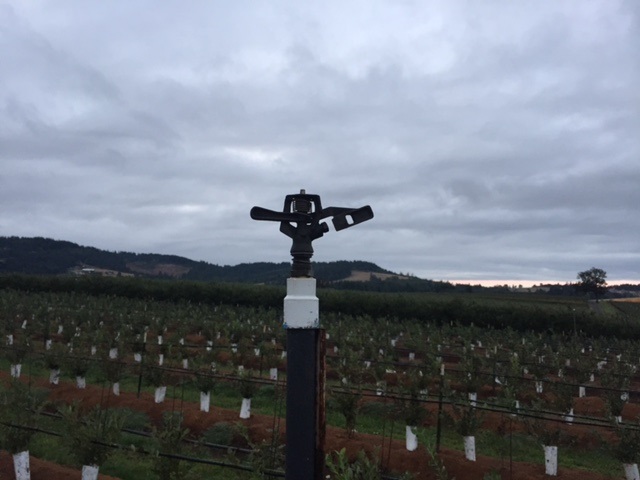
Sullen skies, heavy with moisture. Young plants, hopeful and eager to grow, mature, produce.
The skies “send forth rain and snow in season, giving seed for the sower and bread for the eater.” God’s provision for growth usually comes that way – slowly, incrementally, episodically, often without noticeable accumulation. Yet not always. Not always in such measured fashion, gently and tenderly. Sometimes it comes in quite a different fashion.
They call this an ‘impact sprinkler’. It operates by the jarring impact of a stubbornly spring-driven diffuser as it meets the irresistible force of the pressurized stream of water. Impact! – rebound … impact! – rebound … impact! – rebound … Bursts of water, sent arcing away to accomplish their purpose; jerkily moving the sprinkler through its prescribed path to accomplish the goal and facilitate growth.
There are times when growth is accomplished by the tender precipitate of sullen clouds. There are times when the jarring impact of intervention is more effective. Both are required for maturity and health.
from September 8, 2016

Alone
It is overwhelming to be alone, without validation; to be that one lone voice, the only one with enough clarity, enough honesty, enough integrity, enough insight. The only one to make that observation, to stand for that principle, to speak that truth, to defend that individual. Alone. It’s a depressing place to be. You want privacy, to sit in isolation, to be solitary. You have been abandoned.
But Elijah himself went a day’s journey into the wilderness and came and sat down under a broom tree. And he asked that he might die, saying, ‘It is enough; now, O LORD, take away my life, for I am no better than my fathers.’
You may recall this narrative from 1 Kings 19. Elijah, the prophet of the LORD, had been called to difficult service. His task was to call Israel to penitence. A call which elicited resistance and antagonism. Exacerbated by years of punitive drought, repeated attempts to violence, threats and taunts – Elijah felt further and further alienated. Though vindicated personally at Mt. Carmel, matters seemed to go from bad to worse. Fleeing before the murderous threats of Queen Jezebel, despairing of life itself, Elijah found himself sitting under a lonely tree, sure of his abject singularity. Alone.
Have you been there? I suspect you have. I have. Many have. Perhaps not as a rejected prophet, but alone to be sure. We find ourselves alone, seemingly abandoned by any who could assist or support. Family conflict, work distress, economic anxiety, hopeless in the face of social unrest, overwhelmed by personal guilt … they all have a way of pushing us to the assumption that we are alone, abandoned. We cannot see significant effect of our labors. Our action are misunderstood, or worse – attributed to nefarious intent. The list of our accomplishments, the beneficial outcomes we hope to achieve, they appear to be no more lasting or substantive than the generations who went before us. “I am no better than my fathers” indeed. We identify with Elijah and his lonely broom tree. It might be the only companion we have left.
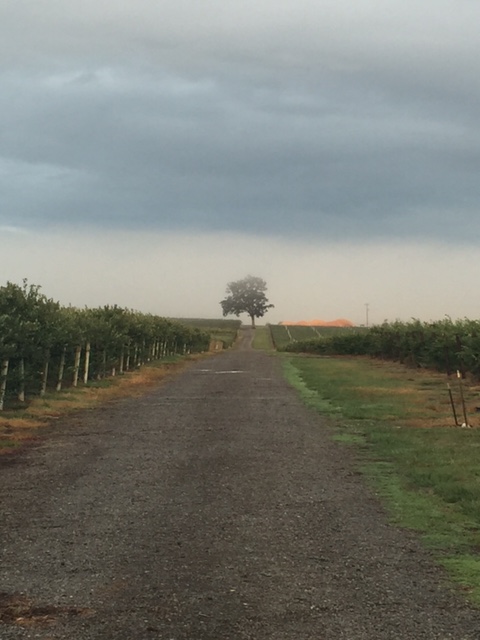
In the image above, there is hope that is unseen. If we could but crest the top of the hill we would see a veritable forest of oaks, just beyond. The solitary tree is not at all alone. From the perspective of the camera lens, it is alone, singular, isolated, abandoned. Walk but a bit farther, and the lone tree has many fellows, kindred, companions arrayed in rank.
Elijah was sure he was alone and without peer, invalidated and used up. God needed to turn his gaze away from his injury and discouragement to see that there were yet 7,000 who were faithful. He was not so alone and he feared. There was work to be done. Anoint foreign kings who serve and work. Anoint a successor in Elisha. The work will continue, and Elijah will find himself among compatriots who will share his work and provide encouragement.
We may feel alone, overwhelmed, without peer or support. Perception is reality, we have been taught to say, and so it may well be. The perception of isolation and aloneness is something many struggle with. Yet there is hope. The God who knows us knows us well. He knows our struggles and He knows our isolation. He also knows that we are not alone. He is with us and we are His. We crest the hill.
from September 6, 2016

The image in question cannot be reproduced due to intellectual property rights. It is a wonderful image however. You can view it here: http://www.jack-vettriano-prints.org/jack-vettriano-prints/jack-vettriano-The-Weight (edit August 28, 2020)
Relic
The image above is one of my favorites by Jack Vettraino, entitled “The Weight”. They say that beauty is in the eye of the beholder, and so also can be meaning (particularly with art). The Weight of what? What is this guy doing? Is he considering options for the future, none of which seem likely to produce a good outcome? Is he alone in a hotel room, burdened by the inescapable consequences of a disastrous choice? Is he absent from his family, forced to ‘go to where the work is’ to provide? Is he lonely? Is he praying? Is he a pastor?
One of the things by which I am drawn to Vettraino’s art is his depiction of vintage, period characters and their context. Relics like snap-brim hats, high-waisted trousers and double-breasted jackets, elegant dresses and heels, vintage autos in their natural environment, even the ubiquity of cigarettes … these speak of a time that was different from our own. Don’t misunderstand – I do not pine for another time in which technology was rudimentary, for I am no Luddite. I do however, find myself drawn back to a time when face-to-face relationships were the norm, when a handshake was firm and the gaze was open, when roles and expectations were clearly expressed, and when one’s community was a significant contributor to his daily life. I find myself standing astride the line between that time and our own. Perhaps I am myself a relic. A relic of another time.
Recently I was asked about my professional approach, my pastoral attitude. Am I a ‘program guy’, promoting and deploying the latest scheme of “10 steps to a happy ___(name your outcome)___?” Do I invest my time in developing leadership within the congregation? Am I building my own kingdom? I must confess to being more like Daedalus in this respect than his eager son Icarus. The notion of flying free, soaring to new heights of institutional advancement can be exhilaratingly attractive. However, the mundane stability of staying closer to the ground, taking care of business is more my speed. Some may call this ‘plodding’. Perhaps. Perhaps plodding is the sign of being a relic.
“Taking care of business”. That is a curious expression to use in the pastoral office and in the church. I am not speaking of balancing budgets and expanding membership. No, that to which I refer is the care of souls. German theologians had a wonderful term for it – Seelsorge – “soul care”. This is what a pastor is and does. He prays for & with the hurting and the hopeful. He visits the sick and the homebound. He makes time in his schedule for those who need his ear and his word, despite the crowded calendar on his device. He reads and hears the Word of the Great Shepherd of the sheep for he himself is one of those sheep. He learns what it is to be a sheep so he can be prepared to care for his own portion of the flock. He proclaims the need for mercy and then delivers the promise of the same, in word and action.
Perhaps he is that man of which Vettraino paints. Perhaps he is the man, alone in prayer, bowed down by the weight of human need and hurt, finding comfort and help in his God. Perhaps Vettraino paints a pastor. He certainly paints a relic; a man from another time. I guess that’s what I am … a relic of another time.
from September 2, 2016

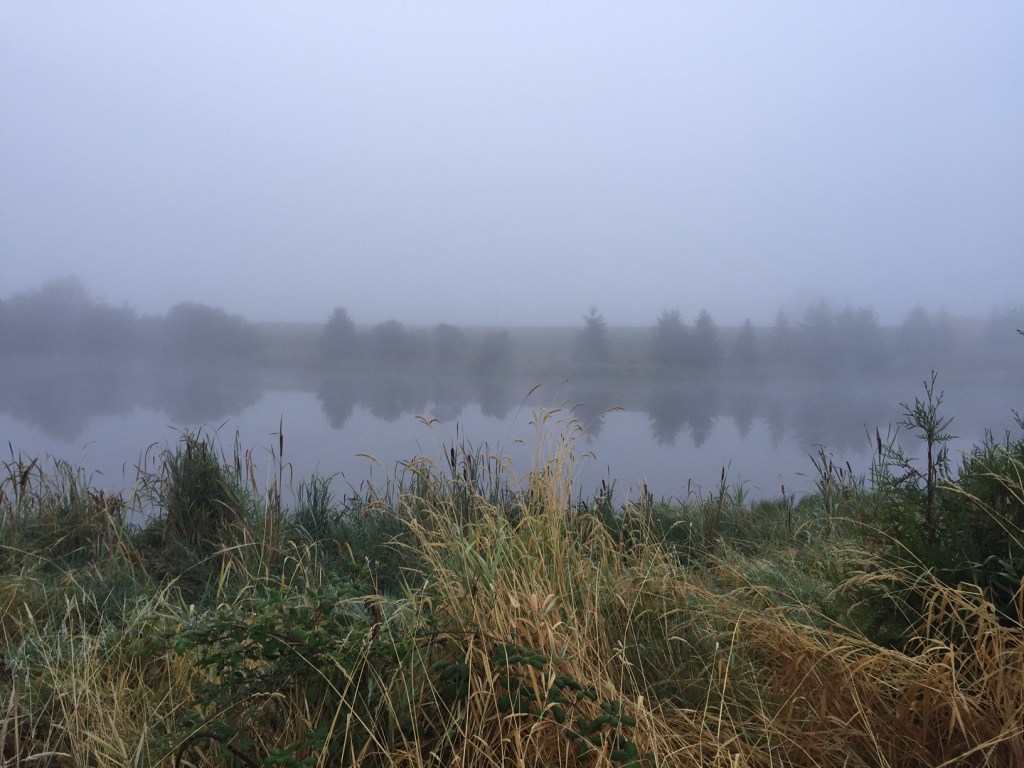
This is the vista on my morning walk today. The settling fog shortens the depth of my view, though not unwelcome. Those items in the foreground are in sharp relief and knowable, while those more distant seem uncertain. Curiously, were I to stand on the other shore, it would all be different, yet the same. It is all a matter of perspective.
I know this body of water well, though it still has its secrets, coyly withheld. If not intimately acquainted, we are certainly on a first name basis, this pond and I. I know its shallows and weedy lies. I know where the shadows fall early in the morning, and where they linger as the sun ascends. I have learned the places to avoid as a bad bet, and which cover deserves special attention. I know this place. It knows me. Yet this morning it presents itself as reticent, retiring, and elusive.
This is as it is today. Yesterday it was different, though the same. The week before it was harsh, a hot sun glaring off the flat water, uncomfortable on the eyes. Tomorrow, next week, next month, next year … who can say? Although impounded, it is always nuanced, as Heraclitus said. I suspect he knew not only water, but himself as well.
You see, I think this place is me. I am unyielding, yet approachable. I am clear and forthright, and yet maddeningly unclear. I am sensitive, and yet cold and withdrawn. I am the same person today and tomorrow, though it seems impossible for there is such disparity. One day it is the lee shore that is mist-shrouded, the next it is the windward that hides. I am constantly inconstant. It is indeed a matter of perspective.
In the breach, I thank God for His constancy, His dependability, His stability. St. James writes “Every good and perfect gift is from above, coming down from the Father of the heavenly lights, who does not change like shifting shadows. He chose to give us birth through the word of truth, that we might be a kind of firstfruits of all He created.” THAT’s me. His child, birthed through His word of promise. I am constantly inconstant indeed; curiously withdrawn and yet knowable. I am given stability and a solidity that belies my character. I am made His. His. Perspective.
from September 1, 2016

Follow My Blog
Get new content delivered directly to your inbox.
 mwarmbier1.com